Aiforia partners with PathPresenter to accelerate the adoption of digital pathology and AI

Collaboration aims to broaden the reach and adoption of Aiforia’s AI-powered image analysis solutions by utilizing PathPresenter’s comprehensive pathology workflow platform

Aiforia Technologies Plc, Press Release, March 21, 2025 at 2:00 p.m. EET

Aiforia Technologies, a pioneer in AI-driven diagnostics in pathology, has announced a new partnership with PathPresenter. This collaboration aims to broaden the reach and adoption of Aiforia’s AI-powered image analysis solutions by utilizing PathPresenter’s comprehensive pathology workflow platform. By combining their distinct expertise in digital pathology, the companies aim to provide pathologists with enhanced diagnostic capabilities and streamlined end-to-end workflow management solutions.

“This partnership with PathPresenter is a significant step in expanding the reach of Aiforia’s AI solutions in the United States. PathPresenter’s widely used platform connects pathologists globally and provides access to valuable expertise and best-in-class tools. By integrating our technologies, we will enable pathologists to seamlessly access and utilize Aiforia’s AI solutions for image analysis, aiming to improve the speed and accuracy of the diagnostic workflows,” says Jukka Tapaninen, CEO of Aiforia.

“PathPresenter is committed to providing pathologists with the most comprehensive and advanced tools for collaboration and diagnosis. By integrating Aiforia’s cutting-edge image analysis solutions, such as AI models for breast, lung and prostate cancer, we enhance our users’ ability to connect with colleagues, access expertise, and utilize AI models within their existing workflows – ultimately aiming to empower pathologists and improve patient care,” says Patrick Myles, CEO of PathPresenter.”

Further inquiries 

Jukka Tapaninen, CEO, Aiforia Technologies Plc
tel. +33 61 041 6686
https://investors.aiforia.com/   


Certified Adviser

UB Corporate Finance Ltd
ubcf@unitedbankers.fi


About Aiforia 

Aiforia is a trusted provider of deep learning artificial intelligence (AI) solutions for pathology. Aiforia delivers software solutions that elevate diagnostic capabilities in image analysis, enabling remarkable medical discoveries now and in the future. With thousands of AI models already developed on the Aiforia platform for research use and several diagnostic solutions deployed, Aiforia is already significantly impacting pathology and healthcare.

Founded in 2013, Aiforia is a publicly traded company operating internationally with thousands of platform users across the globe. The company is headquartered in Helsinki, Finland, with offices in Cambridge, Massachusetts, and Rochester, Minnesota, and local representatives across Europe and North America. The diverse team at Aiforia includes experienced pathologists, medical scientists, AI and software developers, and a dedicated commercial team. Together, they are working to transform pathology with AI, enabling better care for each patient. Selected Aiforia® Clinical AI models and the Aiforia® Clinical Suite Viewer are CE-IVD marked for diagnostic use in EU and EEA countries; see the full list at www.aiforia.com/aiforia-clinical-solutions. In all other countries, including the United States, the use is limited to Research Use Only.

Find out more at www.aiforia.com 

About PathPresenter

PathPresenter is an enterprise image management and workflow platform for digital pathology. We are on a mission to democratize access to the world’s pathology knowledge by connecting pathologists to the vast expertise of their colleagues globally and providing a practical platform to access and use best-in-class AI models. Founded by dermatopathologist and digital pathology pioneer Dr. Rajendra Singh, PathPresenter’s secure, scalable, vendor-agnostic enterprise pathology workflow software has been adopted by tier one medical institutions for clinical care, education, and research, and the company has built a thriving community of tens of thousands of users around the world to easily view and share digital pathology images and knowledge.

The PathPresenter Clinical Viewer is a digital pathology image viewing and management software. It is approved for research use only and has not been cleared by the FDA as a medical device. It is the responsibility of a qualified pathologist to employ appropriate procedures and safeguards to assure the validity of the interpretation of images obtained using this device. Pathologists should exercise professional judgment in each clinical situation and examine the glass slides by conventional microscopy if there is doubt about the ability to accurately render an interpretation using this device alone.

Learn more at www.pathpresenter.com.

PathPresenter Introduces ConsultConnect, a Zero Footprint Web Portal for Remote Second Opinions

AWS-powered solution enables institutions to scale their pathology remote second opinion programs globally


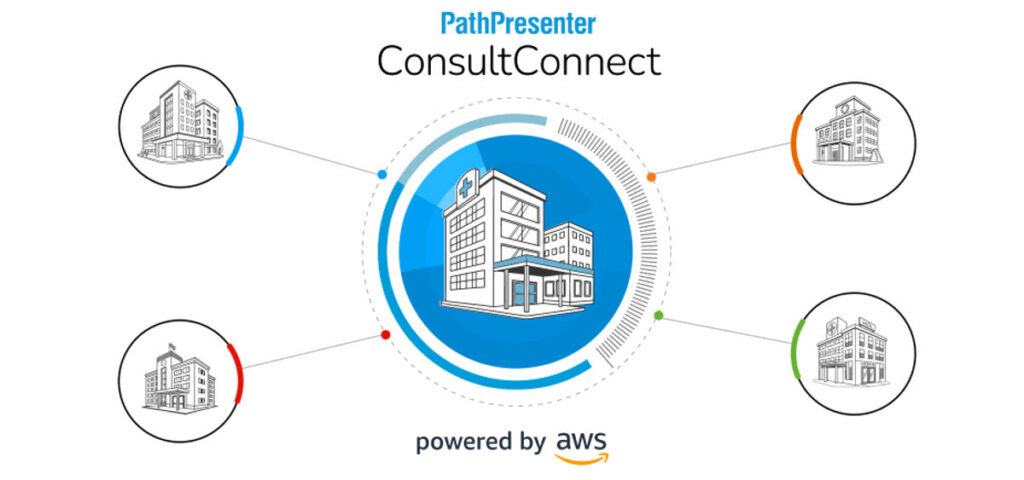
MONTVILLE, NJ / March 20, 2025 / PathPresenter, a leader in digital pathology workflow software, is pleased to announce ConsultConnect, a new solution for digital pathology consultations and remote second opinions. Built by pathologists and powered by Amazon Web Services (AWS), ConsultConnect aims to provide leading institutions with the fastest, easiest, and most cost-effective way to scale their remote second opinion programs globally.

Designed for institutions with significant subspecialty expertise, ConsultConnect addresses the two major barriers to adoption in digital pathology: budgeting and long implementation/integration times. First, ConsultConnect has no upfront implementation fees or subscription fees. Instead, there is a minimal annual commitment and simple “per-consult” pricing. Second, ConsultConnect offers a highly streamlined and simplified onboarding process, allowing institutions to get up and running with their cloud-based solution in days instead of months.

“Digital pathology has long been viewed by institutions as an expense rather than an opportunity. At PathPresenter, we aim to shift that perspective by transforming digital pathology into a profit center while expanding institutions’ global reach,” said Dr. Rajendra Singh, PathPresenter co-founder. “With AWS’s reliable infrastructure and PathPresenter’s expertise, we empower our customers to bridge the gaps in their workflows, making digital pathology a seamless, scalable, and cost-effective solution.”

ConsultConnect features all the tools required by pathologists and institution administrators to deliver remote second opinion services to referring hospitals globally. Core to the platform is a user-friendly, scanner-agnostic image viewer for pathologists to receive, view, and sign out remote second opinion cases. For administrators, the portal provides tools to easily onboard and manage referring hospitals and incoming cases. The zero-footprint platform is monitored 24/7 by industry-leading security and compliance vendor Vanta for HIPAA compliance.

ConsultConnect has been optimized to run on AWS by PathPresenter and partner CitiusTech. With healthcare-focused expertise in medical imaging, CitiusTech leveraged AWS HealthImaging services to ensure ConsultConnect delivers the very best imaging performance and data integrity, including whole slide DICOM file upload functionality. AWS HealthImaging is a purpose-built, HIPAA-eligible service for medical imaging in the cloud, giving customers the performance, scale, and low total cost of ownership needed for large pathology workloads. AWS services provide robust security measures specifically designed for handling patient data across various healthcare entities. With AWS managed services, PathPresenter is providing low-latency, petabyte-scale digital pathology in the cloud.

Early Adopter Program

ConsultConnect will be available to select institutions through an early adopter program. For more information on this program and deploying ConsultConnect, see us at the USCAP Annual Meeting in Boston, MA, March 24-26 in booth 509, or visit www.pathpresenter.com/consultconnect/.

About PathPresenter

PathPresenter is an enterprise image management and workflow platform for digital pathology. We are on a mission to democratize access to the world’s pathology knowledge by connecting pathologists to the vast expertise of their colleagues globally and providing a practical platform to access and use best-in-class AI models. Founded by dermatopathologist and digital pathology pioneer Dr. Rajendra Singh, PathPresenter’s secure, scalable, vendor-agnostic enterprise pathology workflow software has been adopted by tier one medical institutions for clinical care, education, and research, and the company has built a thriving community of tens of thousands of users around the world to easily view and share digital pathology images and knowledge. Learn more at www.pathpresenter.com.

Contact Details

PathPresenter
Neil Humphrey, VP of Marketing
+1 519 498 3402
neil@pathpresenter.com

The PathPresenter Clinical Viewer is a digital pathology image viewing and management software. It is approved for research use only and has not been cleared by the FDA as a medical device. It is the responsibility of a qualified pathologist to employ appropriate procedures and safeguards to assure the validity of the interpretation of images obtained using this device. Pathologists should exercise professional judgment in each clinical situation and examine the glass slides by conventional microscopy if there is doubt about the ability to accurately render an interpretation using this device alone.

PathPresenter and Aisencia partner for AI-Powered Workflows

Calling all AAD2025 attendees! See the future of dermatopathology workflows at the PathPresenter booth (number 816). We have partnered with AI vendor Aisencia to expedite how dermatopathologists sign out cases. Meet with PathPresenter’s Cory Batenchuk, and Catherine Cline and see how to optimize your digital derm workflow for speed, efficiency, and precision.

By combining cutting-edge AI technology with decades of dermatopathology expertise, we have created a unique workflow optimized for speed, efficiency, and precision.

Why Choose PathPresenter + Aisencia?

Our founder, Dr. Rajendra Singh, brings over 20 years of dermatopathology experience to this innovative solution. His insights have been instrumental in designing a system that delivers maximum efficiency and accuracy for dermatopathologists. Aisencia is an AI company specifically focused on dermatopathology and digital workflows, with a first-of-its-kind model that already detects and classifies 50+ types of skin lesions.

Key Features

Smart Case Prioritization

  • AI ranks cases from suspicious to non-suspicious, ensuring high-priority cases are reviewed first.

AI-Powered Macro-Based Reporting

  • Reports are pre-populated by AI for faster sign-out.
  • Upcoming voice command integration allows seamless updates and corrections.

DermPath Assist

  • AI Chatbot trained specifically for dermatopathology 
  • Functions as a co-pathologist, offering diagnostic suggestions based on case features.

Flexible Case Sign-Out

  • Supports TC/PC models for signing out cases by institution or external sites.
  • Dermatologists can push cases back to the main organization when needed.

LIS Integration

  • Fully deployed with CoPath, NovoPath, and Epic Beaker for a seamless workflow experience.

Powered by Aisencia

With AI-based case prioritization and macro-reporting that condenses the results of 50+ precision AI models for dermal lesions, our solution is set to make a significant impact on dermatopathology workflows.

Let’s Connect!

We’re excited to share how AI is reshaping digital pathology. Visit us at AAD2025 (booth 816) and discover how PathPresenter and Aisencia can transform your institution’s dermatopathology practices.

Let’s drive innovation together!

PathPresenter Partners with Leading Global Cancer Center to Integrate AI Module for Oncology Research

“DeepLIIF” algorithm enhances accuracy, reproducibility, and efficiency in pathology, providing a cost-effective solution for advanced biomarker analysis

MONTVILLE, NJ / ACCESS Newswire / March 4, 2025 / PathPresenter, a leader in digital pathology workflow software, is pleased to announce that it is collaborating with Memorial Sloan Kettering Cancer Center (MSK), one of the world’s foremost oncology institutes, to integrate the PathPresenter platform with DeepLIIF, a new AI module for oncology research developed at MSK.

DeepLIIF was created by Dr. Saad Nadeem, Assistant Professor and Director of the Nadeem Lab at MSK, in collaboration with Dr. Travis J. Hollmann, who formerly served as Director of Immunomorphology Platforms and Associate Attending Pathologist at MSK. It is a deep-learning algorithm that transforms standard immunohistochemistry (IHC) images into virtual high-resolution multiplex immunofluorescence (IF) images, enabling automated cell segmentation and precise quantification. This approach enhances accuracy, reproducibility, and efficiency in pathology, providing a cost-effective solution for advanced biomarker analysis.

By integrating DeepLIIF into the Pathpresenter image management system, PathPresenter expands access to MSK’s powerful AI tools, enabling pathologists worldwide to analyze complex pathology images in a research context more efficiently and accurately.

“We applaud MSK’s leadership in continuously advancing the field of digital pathology,” said Dr. Cory Batenchuk, SVP of Operations at PathPresenter. “Dr. Nadeem’s innovation with DeepLIIF represents a significant advancement in our field and we’re delighted to give more pathologists the opportunity to leverage this technology in a research context through the global reach of our platform.”

“DeepLIIF is a novel virtual staining AI algorithm deployed at MSK, following rigorous validation and single-site regulatory approval,” said Dr. Nadeem. “DeepLIIF allows more accurate cellular phenotyping with whole-cell segmentation and is more sensitive to picking out low and ultra-low IHC DAB expression due to the higher dynamic range in co-registered IF images during training. We are excited to collaborate with PathPresenter to extend our reach while expanding our offerings to more complex markers such as PD-L1 and HER2. Working with PathPresenter, we are hoping to follow the same validation and single-site approval process where applicable for clinical deployment while allowing research use by default.”

This collaboration builds upon MSK’s experience and familiarity with PathPresenter during the past five years. More than 150 pathologists within the institution currently use MSK’s customized PathPresenter installation for digital pathology education and research.

DeepLIIF becomes the latest AI application to be integrated into PathPresenter’s vendor-agnostic platform, joining solutions from industry leaders such as Paige, IBEX, 4D Path and MindPeak. With its secure, scalable architecture, PathPresenter offers AI developers a rapid, proven path to deploy their models while providing users with a powerful, consistent workflow for accessing multiple AI solutions.

About PathPresenter

PathPresenter is an enterprise image management and workflow platform for digital pathology. We are on a mission to democratize access to the world’s pathology knowledge by connecting pathologists to the vast expertise of their colleagues globally and providing a practical platform to access and use best-in-class AI models. Founded by dermatopathologist and digital pathology pioneer Dr. Rajendra Singh, PathPresenter’s secure, scalable, vendor-agnostic enterprise pathology workflow software has been adopted by tier one medical institutions for clinical care, education, and research, and the company has built a thriving community of tens of thousands of users around the world to easily view and share digital pathology images and knowledge. Learn more at https://pathpresenter.stg1.parel.co.

Contact Details

PathPresenter
Neil Humphrey, VP Marketing
+1 519 498 3402
neil@pathpresenter.com


The PathPresenter Clinical Viewer is a digital pathology image viewing and management software. It is approved for research use only and has not been cleared by the FDA as a medical device. It is the responsibility of a qualified pathologist to employ appropriate procedures and safeguards to assure the validity of the interpretation of images obtained using this device. Pathologists should exercise professional judgment in each clinical situation and examine the glass slides by conventional microscopy if there is doubt about the ability to accurately render an interpretation using this device alone.

DeepLIIF is for research use only.

Storage: The 800-Pound Gorilla in Digital Pathology

Dr. Rajendra Singh

by Rajendra Singh MD, Co-Founder, PathPresenter
Director of Dermatopathology and Digital Pathology,
Summit Health

The 800 pound gorilla in the room

Digital pathology is transforming how pathology departments operate, offering unprecedented opportunities for research, diagnosis, and education. However, the field faces a formidable challenge: data storage. The scale of the problem is vast and growing, posing one of the most significant barriers to widespread adoption of digital pathology solutions.

The Scale of the Storage Challenge

Pathology departments generate approximately one billion glass slides annually. Each digitized whole-slide image (WSI) ranges from 1 to 10 GB in size, resulting in a staggering accumulation of thousands of petabytes and even zetabytes of data every year. Moreover, the College of American Pathologists (CAP) guidelines require glass slides to be stored for at least ten years. When combined with decades of retrospective data, the sheer volume of storage needed becomes daunting.

Adding to the complexity is the requirement for redundancy in cloud storage. These measures, while critical for data integrity and disaster recovery, exponentially increase storage demands. Moreover, viewing and analyzing these massive files requires high bandwidth, significantly driving up costs. These escalating expenses often make digital pathology appear non-viable for many institutions.

Lessons Learned in Storage Solutions for Digital Pathology

Implementing digital pathology solutions, whether on-premises, cloud-based, or hybrid, has provided valuable insights. Below are some key considerations:

  1. Understand the Institution’s Risk Profile

Cloud Aversion vs. Cloud Adoption: Some institutions are highly risk-averse, preferring on-premises storage solutions to avoid cloud-related risks. Others embrace cloud storage for its scalability and adaptability to rapid technological advances. Increasingly, institutions are opting for a hybrid approach, leveraging the benefits of both models.

Critical Insight: Aligning storage strategies with the institution’s risk tolerance is essential for a successful implementation.

  1. Define the Use Case

Digital pathology use cases vary significantly. Some institutions pursue comprehensive implementation, while others take a phased approach—starting with specific areas like consultations, education, research, or primary diagnosis.

Critical Insight: Tailoring the storage solution to the institution’s immediate and long-term goals ensures resource optimization.

  1. Understand the True Costs of Storage

The cost of storing pathology slides extends beyond the per-terabyte price. Each slide involves millions of write operations for storage and read operations for retrieval, both of which incur separate charges.

Hot vs. Cold Storage: Retrieval speed plays a critical role in cost. Hot storage, which allows instant access, is significantly more expensive than cold or archival (glacial) storage. Developing a strategy to determine what data resides in which tier is essential.

  1. Implement Data Tiering and Flagging Mechanisms

Data tiering ensures efficient and cost-effective storage. For instance:

Hot Storage: Critical cancer cases can remain in hot storage for immediate access.

Cold or Archival Storage: Benign diagnoses and re-excision cases can be moved to lower-cost options or on-premises storage.

Deletion: Data with no foreseeable use can be safely deleted according to retention policies.

Critical Insight: Automated flagging mechanisms streamline this process, ensuring data is appropriately tiered based on clinical and institutional needs.

  1. Establish Comprehensive Policies

Storage strategies must include clear policies on data retention, transfer, disaster recovery, compliance audits, and adherence to regulatory frameworks. Regular reviews ensure policies remain aligned with evolving standards and technologies.

The Path Forward

While storage remains the proverbial 800-pound gorilla in the room, addressing the challenge head-on with thoughtful planning and strategic implementation can make digital pathology a viable and transformative solution. Institutions that successfully navigate the storage conundrum will be well-positioned to leverage the full potential of digital pathology, ultimately improving patient outcomes and advancing medical science.

About the Author

Dr. Rajendra Singh is Director of Dermatopathology at Summit Health and co-founder of PathPresenter. He serves as a member of the Digital and Computational Pathology Committee of the CAP, Editorial Board of the WHO for Classification of tumors, 5th Edition and the Board of Digital Pathology Association.

Overcoming Challenges in Implementing Digital Pathology and AI at Scale: Lessons from the Field

Dr. Rajendra Singh

by Rajendra Singh MD, Co-Founder, PathPresenter
Director of Dermatopathology and Digital Pathology,
Summit Health

Pathologist symbolically breaks chains

When pathologists begin signing out cases digitally, they rarely revert to traditional microscopes. Yet, we have seen this happen. Why would pathologists revert to microscopes. What goes wrong?

One of the most frustrating aspects of digital pathology sign-out is latency—delays in opening or viewing digital slides. When loading a slide takes longer than a few seconds, it disrupts a pathologist’s workflow, leading to dissatisfaction and reduced adoption of digital systems. Seamless, fast image streaming is a cornerstone of successful digital pathology implementation. This is especially critical in high-volume pathology departments producing 1,000 to 5,000 slides per day, with each slide averaging 2–4 GB in size.

Through hands-on experience in implementing digital pathology solutions across departments that generate petabytes of data, we’ve identified and addressed key challenges contributing to image lag. Below are the lessons learned and solutions that have proven effective:

  1. Co-location of Image Storage and Processing Units
  • Challenge: Physical or network separation between storage and processing units increases latency.
  • Solution: Ensure that image storage and processing systems are located in close proximity, whether on-premises or cloud-based. This minimizes delays in slide retrieval and rendering.
  1. Smart Caching Mechanisms
  • Challenge: Frequently accessed slides take too long to load during high-demand periods.
  • Solution: Implement intelligent caching that preloads frequently accessed or recently viewed image files. By “precooking” these files, pathologists experience faster retrieval during active sign-out sessions.
  1. Load Balancing Between Servers
  • Challenge: High data use during peak times can cause bottlenecks, slowing workflows.
  • Solution: Distribute data processing tasks across multiple servers with load-balancing mechanisms. This ensures optimal utilization of resources and prevents delays caused by server overloads.
  1. Flexible Tiling Strategies
  • Challenge: Processing unnecessary image layers increases rendering time.
  • Solution: Optimize image rendering by utilizing only essential resolution layers and removing extraneous regions or layers. This reduces the processing burden and accelerates slide opening.
  1. Hierarchical Storage Solutions
  • Challenge: Storing all images in high-speed storage is costly, while slower storage leads to delays.
  • Solution: Adopt tiered storage systems. Store high-priority or frequently accessed data in high-speed “hot” storage, while archiving less-used data in lower-cost “cold” storage. This ensures critical slides are always readily available without delays.

Let’s Collaborate and Advance

What challenges have you encountered in implementing digital pathology solutions, and what strategies have worked for you? By pooling insights, we can drive faster adoption and optimize the integration of DP and AI into routine practice.

About the Author

Dr. Rajendra Singh is Director of Dermatopathology at Summit Health and co-founder of PathPresenter. He serves as a member of the Digital and Computational Pathology Committee of the CAP, Editorial Board of the WHO for Classification of tumors, 5th Edition and the Board of Digital Pathology Association.

AI in Digital Pathology: Hype vs Reality

Dr. Rajendra Singh

by Rajendra Singh MD, Co-Founder, PathPresenter
Director of Dermatopathology and Digital Pathology,
Summit Health

The promise of digital pathology lies in leveraging AI to deliver faster, more accurate, and more efficient diagnoses. Many organizations are eager to adopt these tools, even without the prospect of additional remuneration, due to their potential to alleviate the workload of overburdened pathologists. However, despite the availability of numerous AI models, their real-world implementation remains limited.

As technologists, what steps can we take to ensure that both pathologists and patients benefit from the practical application of these models?

Key Challenges and Solutions

  1. Data Security and Cloud Integration Most AI models are hosted in cloud environments outside the organization’s DMZ (demilitarized zone), causing reluctance to share sensitive patient data from the IMS (Information Management System) with the model. Proposed Solution: Dockerization of AI modules can enable secure deployment within the organization’s internal infrastructure, addressing data security concerns.
  2. Integration with IMS Viewers AI-generated outputs—such as heatmaps, annotations, bounding boxes, and textual data—often need to be displayed in the IMS viewer. However, most AI vendors mandate the use of their proprietary viewers, leading to workflow inefficiencies. For instance, a pathologist may need to navigate between multiple viewers during a single session, disrupting the diagnostic process. Proposed Solution: AI results must be seamlessly integrated into the IMS viewer. This approach eliminates the need for multiple viewers and ensures a streamlined, efficient workflow for pathologists. Vendors should prioritize compatibility over exclusivity. This is the approach we’ve taken with PathPresenter; our platform seamlessly integrates AI models from multiple AI vendors and innovators including Paige, IBEX, 4D Path, Mindpeak, and AISencia, giving users the choice of tools with a consistent workflow and UI.
  3. Validation in Real-World Settings Validation of AI models using an organization’s own data is crucial to ensure reliable performance. Testing in stand alone environments provided by AI vendors often fails to replicate real-world conditions, leading to unmet expectations. Proposed Solution: AI models should be evaluated in a sandbox environment within the organization’s infrastructure with data from the organization. This allows comprehensive testing with real data and ensures the model performs as claimed before deployment.

What challenges do you see in your environment? The real value of digital pathology will come in when AI models not only help in better and faster diagnosis, but can also be deployed for prognostication and prediction of tretament. Such advancements would not only enhance patient outcomes but also justify and incentivize the costs associated with digitization and AI adoption. As the field progresses, we look forward to the emergence of models that address these broader needs, paving the way for improved clinical utility and the integration of compensation frameworks for the use of AI in pathology.

About the Author

Dr. Rajendra Singh is Director of Dermatopathology at Summit Health and co-founder of PathPresenter. He serves as a member of the Digital and Computational Pathology Committee of the CAP, Editorial Board of the WHO for Classification of tumors, 5th Edition and the Board of Digital Pathology Association.

PathPresenter co-founder Dr. Cory Batenchuk to present with partner Barco at RSNA

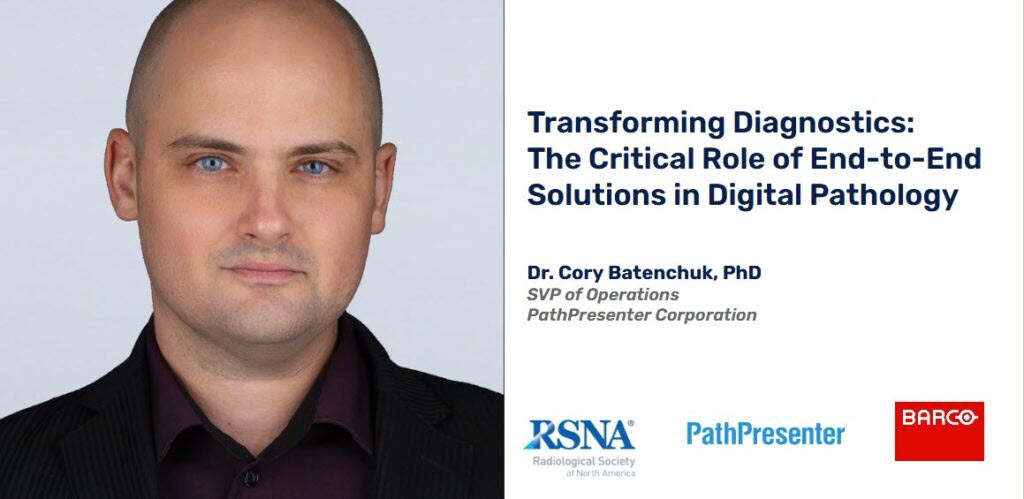
We are pleased to announce that co-founder Dr. Cory Batenchuk will present at the RSNA 2025 conference as one of the Educational Talks hosted by our partner Barco in their “Visions of a healthier world” series. His session, titled “Transforming Diagnostics: The Critical Role of End-to-End Solutions in Digital Pathology” will take place on December 4 at 2:30pm in the Barco exhibit (Booth #3305) in the South Hall of McCormick Place. Don’t miss Cory or any of Barco’s other innovative sessions.

Barco at RSNA 2024
Dec 1-5 | Booth #3305 | McCormick Place, Chicago

Calibration and QA of medical displays | 2 December | 11:30 AM
By Tom Kimpe, VP Technology & Innovation at Barco 

Perception of cine images on medical displays | 2 December | 2:30 PM
By Albert Xthona, Sr. Product Manager at Barco

Color calibration of medical displays | 3 December | 11:30 AM
By Tom Kimpe, VP Technology & Innovation at Barco

Influence of display characteristics on reading efficiency and performance | 3 December | 2:30 PM
By Tom Kimpe, VP Technology & Innovation at Barco

A modern look at ambient light | 4 December | 11:30 AM
By Albert Xthona, Sr. Product Manager at Barco

Transforming diagnostics: The critical role of end-to-end solutions in digital pathology | 4 December | 2:30 PM
By Cory Batenchuk, Sr. VP Operations & Co-Founder at PathPresenter

PathPresenter and Paige Announce Partnership to Accelerate Adoption of Image Management and Artificial Intelligence Digital Pathology Workflows

Paige to participate with PathPresenter at Pathology Visions preconference workshop

MONTVILLE, NJ and NEW YORK, NY– October 16, 2024 – PathPresenter, a cutting-edge enterprise pathology workflow platform known for its secure, scalable, multi-tenant infrastructure, is partnering with Paige, the leader in next-generation AI technology for healthcare. Together, the two companies aim to revolutionize digital pathology workflows in hospitals and laboratories worldwide by integrating Paige’s advanced Diagnostic AI applications directly into PathPresenter’s platform. 

The collaboration between PathPresenter and Paige will offer a unified solution for customers, simplifying AI adoption in pathology and setting new standards in digital pathology management. This seamless integration promises to enhance efficiency and empower pathologists with unparalleled tools for more precise diagnoses and streamlined workflows.

At the highly anticipated Pathology Visions 2024 conference, the companies will unveil this game-changing partnership. On November 3rd, Paige will join PathPresenter for an exclusive preconference workshop, where they will showcase the breakthrough solution developed for Memorial Sloan Kettering Cancer Center (MSKCC).

PathPresenter Preconference Workshop at Pathology Visions 2024:
Topic: Lessons from the Frontlines: Navigating the Integration of LIS, IMS, and AI in Pathology
Date/Time: Sunday, November 3rd, 1:30pm ET
Venue: Hyatt Regency, Orlando, Florida
Learn more about the workshop here.

“We’re thrilled to integrate Paige’s state-of-the-art AI models into PathPresenter’s IMS, elevating the sign-out process while also advancing our educational and research applications. Paige’s innovation – marked by the first-ever FDA approval of a pathology AI application – combined with their exciting Generative AI capabilities, truly has the potential to transform pathology as we know it,” said Dr. Rajendra Singh, founder of PathPresenter.

“We are excited to partner with PathPresenter to bring Paige’s best-in-class Diagnostic AI applications to a broader network of hospitals and labs,” said Peter Hamilton, General Manager of Diagnostics of Paige. “Through this collaboration, we’re advancing our mission to bring our AI to many more cancer patients through partnership, open solutions and industry consolidation”.  

About PathPresenter

PathPresenter is the global image sharing platform for pathology. We are on a mission to democratize access to the world’s pathology knowledge by connecting pathologists to the vast expertise of their colleagues globally and providing a practical platform to access and use best-in-class AI models. Founded by dermatopathologist and digital pathology pioneer, Dr. Rajendra Singh, PathPresenter’s secure and scalable multi-tenant enterprise pathology workflow software has been adopted by tier one medical institutions for clinical care, education, and research, and the company has built a thriving community of 50,000+ users in 172 countries to easily view and share digital pathology images and knowledge. Learn more at https://pathpresenter.stg1.parel.co.

About Paige

Paige is pushing the boundaries of AI to solve cancer’s most critical issues, revolutionizing cancer care with next-generation technology. By leveraging exclusive access to millions of digitized pathology slides, clinical reports, and genomic data, Paige gains a holistic understanding of cancer, encompassing diverse factors such as gender, race, ethnicity, and geographical regions. This comprehensive data enables Paige to create advanced AI solutions that redefine cancer detection, diagnosis, and treatment. With a unique, intricate understanding of tissue, Paige sets new standards in precision diagnostics, earning the distinction of being the first FDA-approved AI application in pathology. Paige has also developed the first million-slide foundation model for cancer, continuing to lead the way in uncovering novel insights and transforming them into life-changing products. For more information, visit www.paige.ai.

Contact Details

PathPresenter
Cory Batenchuk, SVP of Operations
+1 873-355-9913
cory@pathpresenter.com

Paige
Cindi Goodsell | Stanton
cgoodsell@stantonprm.com
510-409-3646